


Your Glasses Are the Only Jewelry You Wear Every Day
Your Glasses Are the Only Jewelry You Wear Every Day
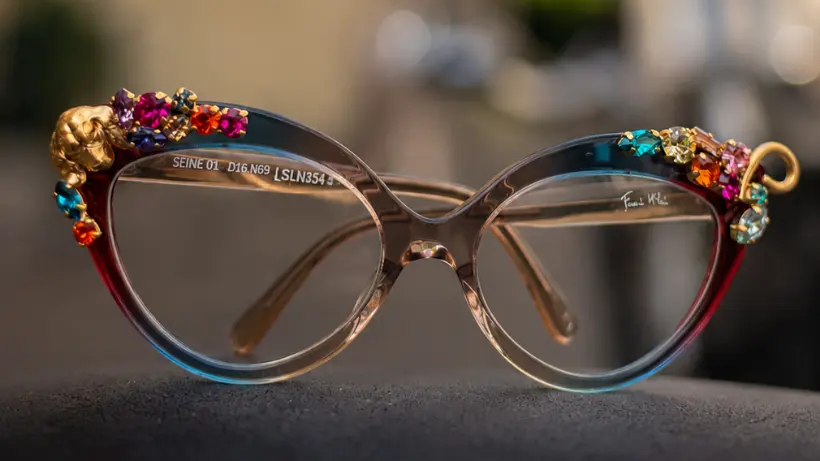
You put them on before your first coffee and take them off at night. They sit at the center of your face, in every photograph anyone takes of you. And still, most people choose them in under ten minutes, off a wall of frames that all look the same. Nobody buys a ring that way.
The short version
- A frame becomes jewelry through three things: material chosen sheet by sheet, decoration set by hand, and a pair made to order rather than pulled off a display.
- Acetate marbled in the mass carries its pattern through the thickness of the material, so every frame cut from the same sheet comes out different.
- Francis Klein has worked this way in Paris since 1970. The house is now run by Betty and Dixie Klein, daughters of the founders.
- Hand decoration covers several separate crafts: crystal setting, engraving, lace and fabric laid inside the acetate, feathers, leather.
- Jewelry does not mean loud. The scale of the decoration is chosen pair by pair, from one golden detail to a full sweep of color.
What actually separates the two kinds of glasses?
Three things separate a jeweled frame from an ordinary one: the material is selected rather than mass-produced, the decoration is applied by hand rather than printed or molded, and the pair is made to order rather than pulled from a display. Price and brand name are consequences of those choices, not the cause.
There are frames that correct your vision, and there are frames that are worn. The difference is not the number on the tag or the name printed on the temple. It comes down to a single question: did someone make a decision about how this frame would look on a face, or only about how many units could come off the line in an hour.
Once you notice the distinction, you cannot stop seeing it. Laid out side by side, it looks like this.
| Ready-made frame | Made-to-order frame | |
|---|---|---|
| Material | Injected plastic or standard acetate, catalog colors | Acetate sheets chosen individually, some from vintage stock |
| Decoration | Printed, molded or applied by machine | Set by hand: crystals, engraving, inlaid lace and fabric |
| Variation | Identical from the first pair to the ten-thousandth | No two pairs strictly alike, even in the same colorway |
| Choice | What the store has in stock, in your size | Shape, color and decoration decided pair by pair |
| Wait | Same day, once the lenses are cut | Made after you order it, through several workshops |
| Life span | Often replaced within two or three years | Kept and relensed, added to rather than replaced |
Is the material chosen, or accepted?
Most frames are molded from the same plastic in a handful of catalog colors. An acetate frame is cut from a sheet, and when that sheet is marbled in the mass, the pattern runs through the thickness of the material rather than sitting on the surface. Every frame cut from it comes out with a pattern of its own.
This is the part almost nobody explains, and it is the one that changes how you look at a frame.
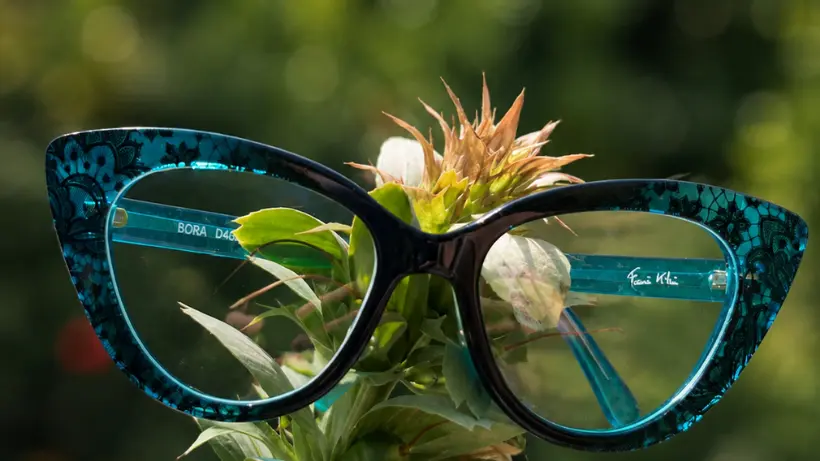
Acetate arrives at a workshop as a flat sheet. The frame front is cut out of it, the way a shape is cut out of a marbled sheet of paper. When the color has been worked through the whole thickness of the material rather than printed on top, that cut reveals a section of the pattern that will never occur again in exactly the same place. Two frames in the same reference and the same colorway are never quite the same object.
Some of the sheets in the Paris atelier are vintage stock that cannot be reordered. When they are gone, that particular marbling is gone with them, which is why certain frames exist in very small numbers without anyone deciding to make them limited.
What does it mean for the decoration to be set by hand?
It means several separate crafts, practiced by different people, on the same frame. Crystals are placed one at a time. Motifs are drawn before they are engraved. Lace and printed cotton are laid inside the acetate itself, which is why those patterns can never rub off. Feathers, leather and golden detail each involve another workshop again.
This is where the comparison to jewelry stops being a figure of speech. The gestures are the ones a jeweler uses, and so is the patience. A single frame can pass through several workshops before it reaches an optician’s tray, each one adding one layer and handing it on.
The detail worth knowing, because it decides how the frame ages: a pattern laid inside the material behaves differently from a pattern applied on top of it. Printed decoration wears at the contact points, at the temples and the bridge, exactly where your fingers go a dozen times a day. Lace or fabric taken into the acetate has nothing to wear off. It is still there in ten years.
If you want to see what those crafts produce on a finished pair, our article on the animal collection follows one motif from drawing to frame, and the piece on handmade eyewear since 1970 goes through the crafts one by one.
Are two pairs ever identical?
No, and for two reasons that compound. The acetate gives each frame its own marbling, and the decoration is then set by hand, piece by piece, so no two applications land exactly the same way. Add the fact that shape, color and ornament are chosen pair by pair, and the object is effectively unrepeatable.
Francis Klein frames are made to order. That is the opposite of walking into a store and taking whichever of the display models happens to fit. Your optician places the order with the atelier in Paris, and what comes back was made after you asked for it rather than in anticipation of someone like you.
Frames can also be ordered without decoration, which surprises people. If you want the shape and the acetate and nothing else, that is a legitimate order, and it tells you something about how the house thinks: the ornament is an option, not a signature imposed on the customer.
It takes longer. That is the trade, and it is the same trade you accept for anything made rather than manufactured.
How should you choose a frame like this?
Ask the questions you would ask about a piece of jewelry rather than about a medical device. Does the color do something for your skin, your eyes, your hair. Does the shape look like you on a good day. Do you actually want to be seen in it. Face shape matters, but it is the last filter, not the first.
Ask most people what they want from a new pair of glasses and they will answer some version of: something that suits me, nothing too noticeable. Which is a strange thing to want from the one object you wear on your face every single day. Nobody chooses earrings hoping they go unnoticed.
The face shape guides that fill the internet are not wrong, they are just placed first when they should come last. They tell you which shapes balance your proportions, and that is useful. They cannot tell you which color makes your eyes look like they have had eight hours of sleep, or which frame you will reach for on a bad morning. Those are the questions that decide whether you wear a pair or leave it in a drawer.
A practical order that works: color first, because it is the thing you cannot fix later. Then scale, meaning how much of your face the frame occupies. Then shape. Then the decoration, which is the easiest to adjust because it is chosen separately.
Do they last?
Yes, and this is where the economics turn. Lenses get replaced and prescriptions change, but a well-made frame does not go anywhere. People who buy this way tend not to replace their glasses so much as add to them: a second pair, then a third, each for a different mood.
The quiet arithmetic of it is worth stating plainly. A frame you keep for ten years and wear every day is not an expensive object, whatever it cost on the day. A frame you replace every two years because you never really liked it is, and nobody counts it that way.
Care is the same as for jewelry, and about as demanding. A soft cloth rather than an ultrasonic bath, the case rather than the table, and a visit to your optician once a year so the fit is adjusted before something is forced. Acetate can be repolished, which is why a frame from the seventies can come back looking close to new.
Does “jewelry” have to mean loud?
No, and this is the misunderstanding worth clearing up. Jewelry is not defined by how much noise it makes. A wedding band is jewelry, and so is a diamond the size of a walnut. What they share is intention, not volume. The same is true of a frame.
A decorated frame can be a single golden detail at the corner, catching the light only when you turn your head. It can also be a full sweep of color and crystal that walks into the room ahead of you. Both come out of the same atelier, and the choice between them is yours to make on purpose rather than by default.
The fear behind the question is usually a specific one: I will look like I am trying. It is worth naming, because it is the single most common reason people talk themselves out of a frame they love in the mirror. The answer is that a frame chosen for your coloring and your proportions does not read as effort. It reads as someone who knows what suits them, which is a different thing entirely and considerably rarer.
Where do you start?
On your face, and preferably in a store. Photographs flatten the two things that matter most here: how a color reads against your skin, and how light moves across a set stone when you move. This is why the frames are sold through opticians rather than online, and why the house holds trunk shows through the year.
Francis Klein works with opticians around the world, and the Paris showroom receives visitors during the week. Through the year the collection travels to partner stores for trunk shows, which is often the easiest way to see a wide selection at once without crossing an ocean.
If you would rather narrow things down before going anywhere, the house also offers a video appointment: you talk shapes and colors with the team, camera on, and arrive at your optician knowing roughly what you are looking for. It costs you half an hour and saves the part of frame shopping that everyone dislikes.
- Francis Klein Paris, Who we are: history of the house, crafts involved, made-to-order process. Consulted August 2026.
- Francis Klein Paris, The collections: frames available with or without decoration. Consulted August 2026.
- Details on materials and workshops come directly from the Paris atelier. This article is first-party: it describes how this house works, not the eyewear industry as a whole.
Frequently asked questions
What makes eyeglasses jewelry rather than just frames?
Three things. The material is selected sheet by sheet rather than mass-produced, the decoration is applied by hand instead of printed or molded, and the frame is made to order, so no two pairs are strictly identical. What changes is the intention behind the object, not only how it looks on the shelf.
Are jeweled eyeglasses too much for everyday wear?
Not necessarily. Jewelry is not loud by definition, it is considered. A decorated frame can be a single golden detail at the corner or a full sweep of crystals, and the same atelier makes both. The scale of the decoration is a choice you make, not a condition that comes with the category.
Can jeweled frames take prescription lenses?
Yes. These are optical frames, glazed with prescription lenses by your optician exactly like any other pair, including progressive lenses in most shapes. The collection also includes sunglasses, and an optical frame can usually be fitted with tinted lenses if you want a second pair in the same shape.
Why are no two Francis Klein frames identical?
Acetate is cut from sheets that are marbled in the mass, meaning the pattern runs through the thickness of the material rather than sitting on the surface. Every frame cut from a sheet comes out with its own marbling. The decoration is then set by hand, piece by piece, which adds a second layer of variation.
Can I choose the color and the decoration of my frame?
Yes. The frames are made to order, and the shape, the color and the decoration are chosen pair by pair. Your optician places the order with the atelier in Paris. Frames can also be ordered undecorated if you want the shape and the acetate without the ornament.
How long does a made-to-order frame take?
Longer than taking a frame off the display, because the pair is made after you order it and passes through several workshops. Your optician will give you the current lead time when the order is placed. It is the same trade you accept for anything made rather than manufactured.
Are decorated frames only for women?
The Francis Klein collection is designed mainly with women in mind, and that is how the house describes it. But nothing in a marbled acetate or a hand-set detail is gendered by nature, and the shapes range from openly ornamental to quite sober. The question is the frame, not the category.
How do I care for a frame with crystals or inlays?
Treat it as you would a piece of jewelry. Clean it with a soft cloth and a mild solution rather than dropping it in an ultrasonic bath, store it in its case instead of face down on a table, and have your optician check the fit once a year. Patterns laid inside the acetate cannot rub off.
Where can I try Francis Klein eyewear?
Through opticians around the world, and at the Paris showroom. The house also holds trunk shows in partner stores through the year, and offers a video appointment so you can talk through shapes with the team before you go anywhere.
Find your pair
Browse the collections, or find the optician nearest you. And if you would rather narrow things down first, book a video appointment with the team, camera on.
Keep reading
Handmade decorated eyewear, designed and crafted in France since 1970.
Wear your spirit: the animal eyeglasses
A crane for grace, a panther for quiet power, a bee for warmth and work.
Read the article CraftsmanshipHandmade in France since 1970
Four artisan crafts, one family, zero mass production, from acetate to hand-set crystal.
Read the article The houseWho we are
A Parisian family house, two sisters, and one idea about what glasses are for.
Our story